Tuesday, October 11, 2011

Mega Bargain of the Day: Sega SG-1000 II Console

I`ve had a string of good luck at Omocha Souko over the past week and in this post I thought I`d introduce yet another one of my finds: the sexily named Sega SG-1000 II.

I found this one in the junk section, which has been unusually well stocked recently. It cost me 500 yen (about 7$), 300 for the console itself and 100 yen each for the controllers.

This is one of those consoles that I have been trying to find a cheap copy of for a long time. They are much harder to find than Famicoms are. They had one at Mandarake a few months ago that was semi-complete for 6300 yen, which I came very close to buying before someone else beat me to it. Having just bought one for less than 1/10th that much, I`m glad they did.

This one is a bit worn and dirty, but I kind of like that. It looks like it has been well used, but not over-used to the point that something has broken off of it. That is the perfect amount of wear in my books.
This is one of those early Sega consoles that doesn`t get much attention. The first time I saw one I thought it was the Japanese version of the Sega Master System, but it isn`t. The Sega Mark III, which looks almost exactly the same as the SG-1000 II on the outside, is the Japanese version of the Master System (or, more accurately, the Master System is the overseas version of the Mark III).

The SG-1000 II is an earlier console based on an even earlier one, the SG 1000, which was released in Japan on the exact same day as the Famicom (July 15, 1983, mark it on your calenders).

I kind of like the look of it. Clumsy but in an understated way. The controllers are extremely spartan in design:
They snap right on to the sides of the console, which is kind of handy. As with the Famicom they made the mistake of having the controllers wired into the back of the console instead of the front, which significantly reduces the distance from which you can sit and use the console.

Perhaps its most interesting feature from an aesthetic perspective is the little piece of video game literature stamped on the surface:

`A fun packed console designed for simple operation. This computer video game with its distinct images allows you to enjoy the maximum in playing satisfaction. Its colorful gameplay is sure to test your skills, sharpen your reflexes and greatly expand your imagination.`

The English is grammatically correct, indicating that it was at least proof read by a native speaker before they started churning them out of the factory. I love the fact that it nonetheless remains a literal translation of the original Japanese in which it was undoubtedly first composed, rendering the resulting English prose clumsy and hamfisted but in a charming sort of way.

Anyway, I also found a game to go with it, the Pro Baseball Penant Race, that I also found in the junk box.
Being new to the whole vintage Sega scene I just looked at the back of the packaging and saw a picture of a console that looked like the one I was buying so I didn`t actually read the fine print.
The console in that picture is actually the Sega Mark III, which as I mentioned above looks almost exactly the same as the SG-1000 II. If I had looked carefully I would have noticed the writing in the white box near the top which says `Cannot be used with the SC-3000 or SG-1000 series`.

So once again I am left with retro game stuff that I cannot test because I don`t have anything to test it with (nor do I have an AC adaptor or RF switch). This is becoming a growing theme in my collection, with my new Super Cassette Vision games (no console) and my Cassette Vision console (no games). Anyway, someday I`ll get the stuff I need to test this baby out!

Related Posts
Mega Bargain of the Day: Pile of Super Cassette Vision Carts
The Famicom Robot: A Day in the Life of

Friday, October 7, 2011

Mega Bargain of the Day: Pile of Epoch Super Cassette Vision Carts

I was at Omocha Souko today browsing their junk section. It has been an amazing week for me there, I picked up the Famicom Robot a couple days ago for a steal. Today I found something just as good.

As I was looking at the usual junk, I noticed these babies sitting on a bottom shelf:
I couldn`t believe my eyes. Fourteen Super Cassette Vision carts just sitting there in the junk section.

Just to put into perspective for you how hard these things are to find, I have spent a ridiculous amount of time over the past 3 years wandering through the aisles of pretty much every game store in this city. Before today I had never seen a single Super Cassette Vision cart in my life. These things are massively hard to find, even Mandarake doesn`t have any. A quick search on Ebay just now turned up only a handful of the things, the lowest price for a single game being 24$. Yahoo Japan Auctions has them for slightly lower starting bids, but even there the pickings are slim. These are about as rare as retro video game carts come.

I knew I had to have them, they just looked way too amazing to leave there. The only problem was that I didn`t know how much they were. The junk section at Omocha Souko is usually just for consoles and accessories, not games, so they only had prices listed for those things.

I flagged down one of their staff and asked how much. He didn`t know and went to go ask one of his supervisors in the back. I stood guard in front of the shelf while he did so, warning off would-be Epoch Super Cassette Vision cart purchasers with my nasty `These Epoch Super Cassette Vision carts are MINE` look (trust me, you don`t want to see that look).

He came back a minute later and said `100 yen each.`

`I see` I said, rubbing my chin as though weighing the purchase decision `thank you`.

As soon as he was around the corner I grabbed a basket, slammed my forearm onto the shelf and swept the whole lot into it in one motion. I then speed-walked to the cashier to pay for them immediately and get the hell out of there before they changed their mind.

These things are just amazing. If you are a regular reader of this blog you know that one of the reasons I love Famicom carts so much is how colorful they are. They just look a million times cooler than the boring grey Super Famicom or NES carts.

Until today I had never seen a video game cart that could give the Famicom cart a run for its money in terms of appearance, but I have to say the Super Cassette Vision carts do. Just look at those colors:
Amazing.

The carts are about two-thirds the size of a Famicom cart:
The main surface label on each is a mini instruction manual that tells you which controls do what in the game:
And the top label has the name of the game, making them extremely easy to identify when stored:
Unfortunately the one thing I am missing is an actual Epoch Super Cassette Vision console to play these on. I have an Epoch Cassette Vision (without the `Super`), but they aren`t compatable with it. Someday though I am going to figure out what Comic Circus, Milky Princess, Elevator Fight, Ton Ton Ball, Miner 2049er, Punch Boy and...well all of these games are like. They sound awesome.

I might add a bit here about the history of Epoch and these games as it is kind of interesting and not much has been written about it in english. When you read about the history of video games, the 3rd generation is usually portrayed as a two-way race between Nintendo and Sega which Nintendo overwhelmingly won with the NES/ Famicom.

In Japan though it was more of a three-way race won by an even more overwhelming margin by Nintendo over Sega and Epoch (and Bandai and Atari, which also made attempts to compete).

Epoch actually beat Nintendo to the chase though by releasing the Cassette Vision in 1981 - the first successful cart-based system to be released in Japan. At one point they controlled 70% of the Japanese home video game market. The release of the Famicom in 1983 wiped that out completely.

The Super Cassette Vision was Epoch`s attempt to compete with Nintendo to regain some of its market share. It teamed up with NEC (later maker of the PC Engine) to develop the hardware, which was released on July 17, 1984.

The system never took off and Nintendo was able to capture 95% of the Japanese market during that generation. The Super Cassette Vision was discontinued in 1987, with thirty games having been released for it. Shortly thereafter Epoch started releasing titles on the Famicom as a third party developer.

Anyway, its an interesting snippet of Japanese video game history. And I just grabbed almost half the console`s entire library of software for about 20 bucks!

Related Posts:
Mega Bargain of the Day: KousenjuuSP Electro Safari
Flea Market Finds: Epoch Cassette Vision

Thursday, October 6, 2011

The Famicom Robot: A Day in the Life of

His name is Phillip, but you can call him Phil. Everyone does. He is a robot. A Famicom Robot.

His day begins on the floor amid a pile of empty girly drink cans. Evidence of his frustration at the world that has denied his genius at every turn. The gentle nudging of Doogle brings him to consciousness.
He has his daily 9 o`clock ping pong session with Richard Branson. He loses every game. He is too short to see the table top.
The afternoon sees him having high tea with Mr. Floppers, his best friend in the world. Today they talk about their shared sense of relief that Sarah Palin will not be running for president.
Five o`clock and the Muscle Men drop by for a visit:
Ten o`clock and it is once again time for bed. He bids Doogle a good night and retires for the day.
The end.


Oh yes, everybody, look! I got the Famicom robot! 50% off sale! GET!

He came complete with his box:
And instruction manual:
This guy was a steal, usually they sell for about 100$ complete like this but I got him for only about 10 bucks. I think that was mainly because when I pulled him out of the box he was covered in orange spots like this:
A bit of scrubbing with a wet wipe got rid of all that though and he looks just like new. The only thing missing as far as I can tell is the battery cover. I`m not sure if he actually works as I don`t have enough batteries on hand and, frankly, don`t really care. I just bought him to look at.

Related Posts
Famicom Light Gun and Wild Gunman
Pachinko and the Famicom: AKA the Stupid Side of Japanese Gaming

Monday, October 3, 2011

Seoul Searching: A 2 Hour Quest for Korea`s Retro Video Games

I just got back from a short trip to Seoul, Korea.

Well, `trip` probably isn`t the right word. I was there for a conference which had nothing to do with video games so I won`t dwell on it here, except to say that it regrettably took up almost my entire time there. I only had a couple of hours to actually explore a country of about 50 million people. If any of you are currently planning a trip to Korea, my advice is to give yourself more than a couple of hours to look around.

Anyway, a couple months ago when I decided to come to Korea, I thought it would be a great opportunity to check out the retro video game shops there and maybe pick up whatever the Korean version of the Famicom was (edit - the Hyundai Comboy).

I did some research online and was quite disappointed by what I found. Korea is quite similar to Japan in many ways and I had assumed that retro video game availability would be one of those similarities. It isn`t. Apparently Korea changed their entire electric power system back in the 1990s, which at a stroke rendered all electronics produced before then completely inoperable. So most of the 80s consoles and video games that I had hoped to find were scrapped years ago and are much more difficult to find than their counterparts in Japan. Even the Yongsan electronics market, I discovered, has virtually no retro games available.

I thus more or less gave up on looking for Korean retro games and reconciled myself to visiting some of Seoul`s more mainstream tourist attractions, like the Gyeongbokgung palace (pictured at the top of this post) which I highly recommend.

I also ventured into Insadong, a shopping district not far from the palace. It was while strolling its streets that I stumbled across the only vestiges of Korea`s video game past that I would discover on my brief trip.

Insadong is a really cool place. Lots of back alleys with trendy shops, restaurants and galleries. As I wandered the main street I noticed in the second floor of one building a number of what looked to be 1980s vintage toys in the window. It looked like it might be a small Korean version of Mandarake. There was a sign on the first floor that was entirely in Korean, which I can`t read, but the picture looked promising.So I ventured up the narrow staircase to the store above.

At the top of the stairs, hidden in a corner by the store`s front door a rotund, middle aged man in a collared yellow shirt sat behind a cramped desk piled high with a ton of junk. He was sleeping soundly as a Korean drama flickered on a TV set. Not another soul was in the shop. But the sight of what laid inside just amazed me:
The place was bursting to the rafters with old toys, piled up in massive quantities in every square inch of space. It was like nothing I had ever seen before. I could barely contain my enthusiasm as I walked past the store`s sleeping owner and began wandering the aisles.

As I wandered, I noticed something a bit strange. None of the merchandise had any price tags on them. This always annoys me when I see flea market vendors who do that. I just never buy anything from them. It was the first time I had ever seen a store like that though.

Then the owner stirred from his nap. `Hello Hello` he called to me `2,000 Won. Camera OK.`

At an instant, the lack of price tags, and other customers, was explained. This was not a store. It was a museum.

I thought about it for a second, then whipped out a pair of thousand Won notes and walked over to hand them to him. `OK, thank you` he said, and then turned his attention to the TV screen in front of him.

As a store, this place would have been awesome. As a museum that charged admission, it was laughably bad. It was just a big room where this guy dumped his lifetime accumulation of toys at random with little attempt at organization or proper presentation, as evidenced by this Last Action Hero Pinball machine buried in a mass of junk:
Yet this chaotic and indifferent approach to display made the place much more entertaining to explore than a professional museum would have been. I spent almost an hour wandering around just gawking at the stuff. Robots lined shelves:
As did chubby helicopters:
And TVs which would have been about Famicom vintage:And, most important for the purposes of this blog, I also found some vintage video game stuff scattered here and there throughout the mess.

Under one glass case was a random pile of old hand helds, including one called Pac Boy:
Another called Submarine Battle was lying on a shelf in some box:Star Force and Galaxy II could be found nestled behind some other retro treasures:As could this blue one, whose name I forgot to write down:The best piece though I found lying on top of one of the cases. A Samsung Gam Boy, which was a dead ringer for the Sega Master System:
It is kind of a testament to just how bad (in a good way) that this museum was that the owner couldnt even be bothered to take the tape holding the AC adaptor off before putting it out for display. It didn`t have any controllers either and the copy of Gallog that it had was in pretty rough shape:I`m not too sure how popular this thing was. Naturally I would have preferred to find the Korean version of a Famicom rather than its prime rival, but given the fact that I only had two hours to hunt for one, this was a pretty good consolation prize.Anyway, that was my trip. I highly recommend a trip to Seoul, it is a great city. I`m already planning a proper trip there someday where I`ll have more than a couple hours to explore!

Friday, September 23, 2011

Double Trouble Donkey Kong Jr. Style: Pulse Line versus Box Art

One of my recent Famicom purchases was another copy of Donkey Kong Jr. I`ve had the pulse line version of this game for quite a while, but I didn`t have the other version. The...uh...one on the right in the above photo.

The subject of today`s post is this duality exemplified in my Donkey Kong Jrs. Most of the Famicom Pulse line carts were released in two versions - the original pulse line version and the other version with the picture from the box art, which were released later.

As a point of nomenclature, I`m not actually sure how to refer to these versions. `Pulse line` is a convenient and descriptive term that is hard to mistake for something else. But what to call these other carts? `Picture carts`? That is short, but not very specific as most Famicom carts have pictures on them. `Box art carts`? Same problem.

Anyway, since I need to refer to them as something in this post, I`ll use the phrase `box art carts` to refer to the versions of the pulse line carts that have box art instead of the pulse line on the cover. Everybody clear on that? Good.

From a collector`s point of view, I`ve noticed some variations in the relative scarcity of the pulse line and box art versions of some of these carts. I think they can be divided into three categories.

1. Pulse Line Carts that have no Box Art version

To the best of my knowledge, the following pulse line carts never had a box art version released:

Donkey Kong 3
Pinball
Donkey Kong Jr Math
Popeye English

I could be mistaken and if anyone knows of box art versions of these carts, please let me know. I have never seen one myself though.

2. Pulse Line Carts that have Box Art versions which were released in roughly equal numbers

For some games that had two versions released, each version seems to have been released in roughly the same quantity and neither is harder to find or more expensive than the other. I would include the following games in this category:

Baseball
Golf
Devil World
Tennis
Mario Bros.
Mah-Jong

There is a bit of variation. The box art version of Mario Bros. seems to be slightly harder to find than the pulse line version, for example, but not too much harder and most shops charge the same price for each if they have them.

3. Pulse line carts that are much easier to find than their box art versions

For some reason a number of carts have box art versions that are significantly harder to find than the pulse line versions and most stores will sell the box art version for a much higher price. These include:

Donkey Kong
Donkey Kong Jr
Popeye

At Mandarake in town here, for example, they have both versions of Popeye available loose. The Pulse line version they are selling for 630 yen (about 9$), while the box art version they are selling for 2400 yen (about 30$). I`m guessing that the reason for this relative scarcity of the later box art versions is that the popularity of those games declined quickly between 1983 and 1985 and thus fewer of the newer versions were sold.

4. Gomokunarabe

This is the one cart which I can`t say for certain which category it belongs in. I have one copy of each version, so I can say that it belongs in either group 2 or 3, but I just haven`t seen enough copies of it in stores to know which is harder to find than the other. Anybody out there know?

Anyway, just thought I`d put this info I had rattling around in my head out there for reference if any of you are trying to collect both versions of these games!

Saturday, September 10, 2011

A Layman and a 6 Month Old Puppy Try to Make a Power Glove Work Without Thoroughly Reading the Manual

Well, the clear shelf space I created through my Famicom sale has lasted all of a week. They were having a 40 percent off sale over at Omocha Souko on all purchases over 2000 yen (about 25$) so I decided to splurge on a PAX Power Glove.

This was sort of me just bowing to the inevitable. I've had chances to buy the Power Glove before but had always resisted the temptation. They aren't generally remembered as one of the better Famicom controllers after all, and they are pretty bulky and take up a lot of space. But after some consideration I decided that no Famicom collection worthy of the name could ever possibly be complete without this weird thing and so I finally caved and bought one.

This is a pretty good one, complete in its box and in almost brand new condition:
When I got my NES at the age of 13 I remember looking in the Zellers catalog and seeing this thing. It was 89.95.

You know what that means, right? Yup, it means that I wanted it so bad that more than 20 years later I remember which department store's catalog it was in and how much they wanted for it.

Of course, in the catalog they only showed a picture of the glove itself, which looks pretty awesome:
Its like having the entire Darth Vader outfit reduced to a glove and put on your hand.

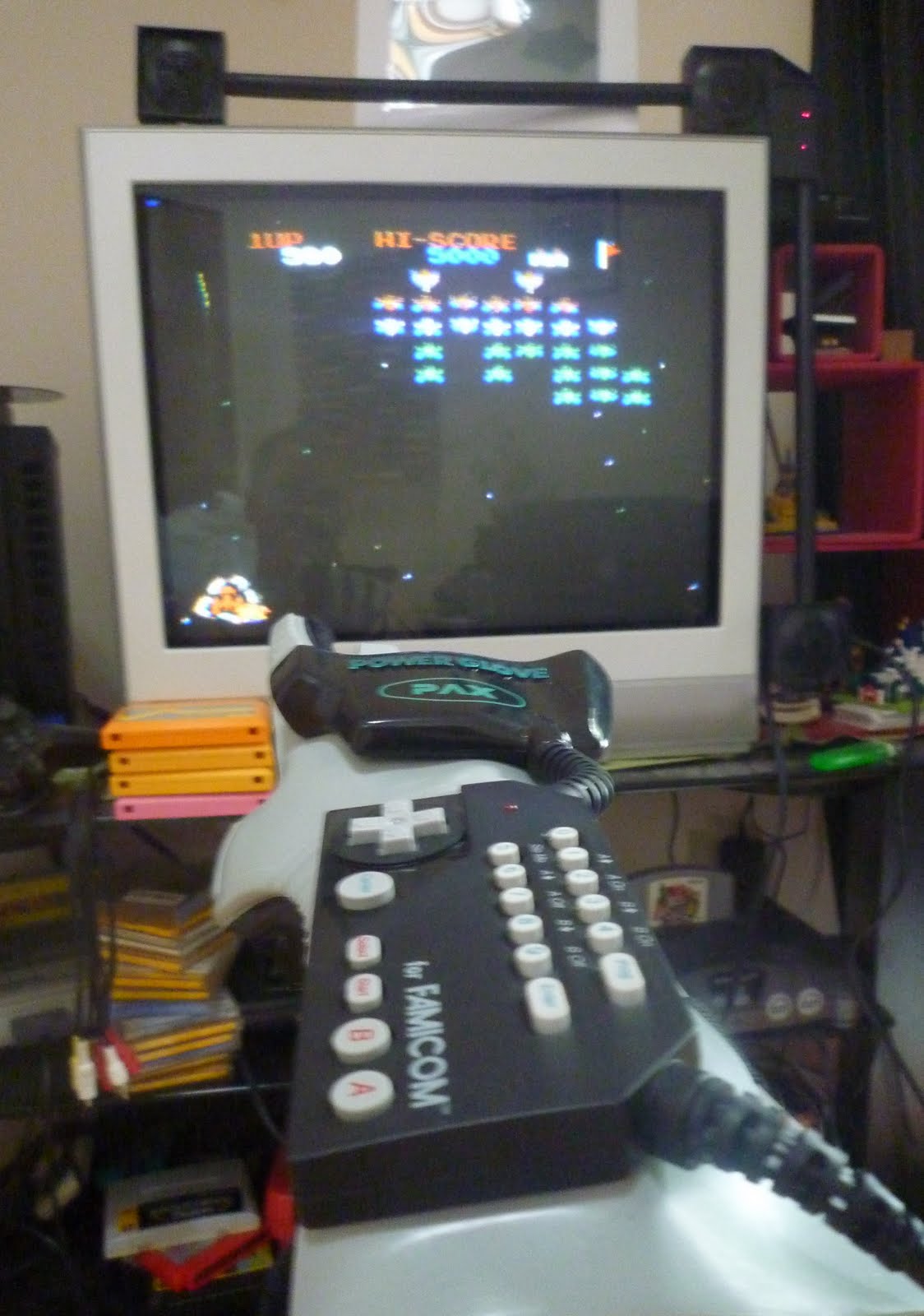
In actual fact though the Power Glove requires a ton of other stuff to make it work. There is this rack thing with sensors that you have to put on your TV:
I was fortunate that our TV coincidentally happens to be the right size for this thing. The manual suggest stacking books on top of your TV if it is too small.

I love the fact that the sensor array has little LED lights that blink on and off seemingly at random while it is on. It looks like some background prop from a Star Trek set or something:
As I tried to play around with it a bit my dog, Doogle, discovered it:
He loves it. It is made of material that is roughly of the same texture and feel as most of his dog chew toys. So from the moment I put it on all he wanted to do was bite my hand.

I hasten to add that he pretty much always wants to bite my hand so this isn't necessarily the Power Glove's fault.

It did complicate matters somewhat though as I'm sure this thing is difficult enough to use even without a 5.4 kilogram fluffball with teeth basically hanging off the thing with his mouth. With one it is damn near impossible. I tried figuring out how to play Galaxian with it. While the spaceship moved around on the screen a bit, I'm not sure if this was in response to my movements or just some random thing that it did.

In fairness though I didn't actually read the manual, which has several pages dedicated to programming this thing, which I assume is necessary in order to make it work properly. Doogle just wasn't having any of that though so I reluctantly put the thing away without having fully realized the awesome potential that the glove promises. Perhaps someday I'll sneak it off the shelf when he is out for a walk with just my wife or something:)

Monday, September 5, 2011

New World Famicom Galaxian Record!!!

As I mentioned in an earlier post a couple months ago, I've been trying for ages to crack the Famicom Galaxian record. Well, at least I've been trying to break the only Famicom Galaxian record that I've been able to find, which was set in 1985 by someone named Hitoki from Gunma prefecture and reported in my Hishousakusen Mecha Guide.

That record was 85,030 points. It pales in comparison to the arcade record listed at Twin Galaxies, which is somewhere over 1,000,000 points but its still a pretty good score. I've never gotten within 20,000 points of it. Until today. Today I finally did it: 97,720 points! Yes!
I had the game of my life. I didn't even loose my first life until just after hitting 70,000.

The best part of breaking the record is that I can finally stop playing Galaxian!! Galaga is way better.

Anyway, short post but I couldn't wait to tell everyone - no point in setting a new high score otherwise:)

Oh and to end this on a petty note: IN YOUR FACE, Hitoki from Gunma in 1985! Oh yeah!